top of page
Caution... things get reel.
Search
  • criticalwritingmovies
  • Dec 2, 2019
  • 3 min read

By: Anna Erickson


It’s like your favorite brownie recipe. You pull the same ingredients out everytime to mix them together in the same way. You know what that brownie will taste like. Yet, the result is nonetheless delectable each time, and with Brittany Runs A Marathon, you’ll be inspired to burn off those calories afterwards, too.

Winning the 2019 Sundance Festival’s Audience Award, this film is undoubtedly a crowd pleaser as it offers a mix of all things familiar in a way that everyone will have a taste for. Based on the true story of director and writer Paul Down Colaizzo’s former roommate and friend, it features the transformation of a wayward and forlorn character named Brittany (Jillian Bell,) when a trip to the doctor reveals her obesity diagnosis, and that she consequently won’t be receiving the Adderall that she intended to score. While working in front of a small non-broadway theater, Brittany struggles with finding purpose and identity in the midst of her trivial job and nights spent in the club, and vows to transform her life with a goal of running the New York Marathon.


The film quickly steps into character roles that it seems every dramedy features, and all doing so in the backdrop of a modern New York City: the funny, yet privately insecure overweight one, the obliviously narcissistic roommate who “can’t do too much cardio or she’ll get too skinny,” a gay guy who befriends the main character, an endearingly irritating co-worker who inevitably turns out to be a love interest, and a sibling who has her life together in a glaringly obvious way. While it seems like we’ve seen all of these characters before, Colaizzo is purposeful in the way that he reveals a surprising amount of emotional depth from them. We learn that there is a lot going on behind the scenes in the lives of each person, bringing them together as they deal with their own personal demons.


One way that the film does step out of the expected is that unlike similar feel-good, motivational films, such as I Feel Pretty, in which Amy Schumer eventually finds satisfaction and confidence in herself without ever actually dropping pounds or changing her appearance, Brittany is empowered every time she steps on the scale and the number is a little lower. In this way, Colaizzo walks the fine line of promoting health while also remaining body-positive, but manages to do so gracefully. As she sheds the pounds, Brittany works on other aspects of her life and eventually jumps back into the dating scene, becomes a “serious” runner and pursues her dream career in jingle-writing for an advertising agency.


Her journey to a new and improved self is a bit of a marathon itself, inducing its fair share of setbacks where at times the finish line seems impossibly far away. Even though the featured impediments were probably foreseen by everyone in the theater, they ended up bringing some of the best elements of the movie to light. It’s the way the Colaizzo uses what could be an ordinary cliche to provide intense and even dark emotional depth in Brittany during what is her lowest point ever. In a bleak and uncomfortable scene, Brittany cruelly insults a woman who is more overweight than she ever was, projecting her own self-loathing in a heartbreaking way.


These small moments are where an incredible sense of reality comes into play, and they allow you to look past some of the average jokes and cheesy pre-race montage. In “Brittany Runs a Marathon,” we learn that first, no one can be happy until they are happy with themselves, and that second, the shittiness of life doesn’t exclude anyone. Most importantly, it allowed me to come to terms with the fact that you can’t really get around adding eggs and butter to your brownie mix (well, you can, but it’s simply not the same).



By: Mara Nelms


Want to know how to say “severe neurotoxicity” in Spanish? Yeah, me too.But if you were expecting to learn any Spanish from Dora and the Lost City of Gold, you shouldn’t hold your breath: Dora mostly ditches its educational origins, which was a letdown to me.

As a whole, Dora and the Lost City of Gold is a charming but mostly unsurprising family film, buoyed by its mockery both of itself and the adventure genre to which it belongs. Younger audiences will be pleased by Dora’s “jungle-schooled” hijinks; the adults paying for their tickets will not suffer needlessly.

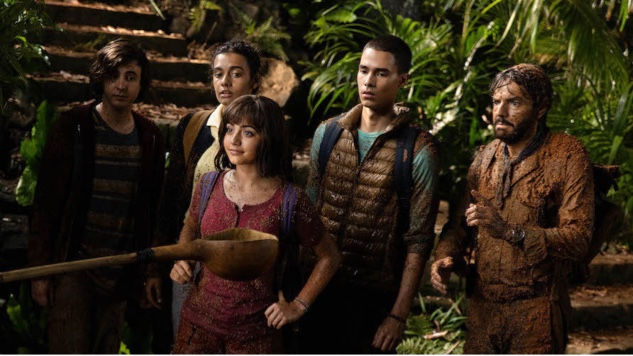
The movie opens with Dora (portrayed earnestly by Isabela Moner) living her best life in the jungle, having been homeschooled there all her life. Neither her sense of fashion nor her social skills have evolved since she was six.

Dora’s parents send her to Mexico to attend school with her cousin, Diego (Jeffrey Wahlberg) while they hunt for Parapata, the Lost City of Gold. Dora doesn’t fit in at high school, embarrasses her more worldly cousin, and is kidnapped along with Diego and two other kids to help some treasure hunters find her parents. That’s not a spoiler, it’s the premise of the movie — but it does take up way more screen time than it should given how boring it is.

After that, the story becomes a fairly standard adventure story with fairly standard jokes: Dora and Co. face off against bad guys, the natural hazards of the jungle, and the intimidating task of taking a poo in a hole in the dirt.

Once the entire first half of the movie is out of the way, the writers seem to let loose a little. The plot goes off the pre-established rails it was following to take a windier, funnier and much more psychedelic path. At times both I and Dora wondered if we were tripping hard, but, you know, in a fun way.

The jokes improve as well, especially for those among the audience who are “in the know” enough to pick up on an almost-swear in Spanish or a bit of biting commentary about colonialism and the United Fruit Company. It’s worth brushing up on your high school level Spanish for that alone.

I have fond memories of my younger sister’s charming childhood obsession with the Dora cartoon series. (She had bedsheets. The pillowcases had pictures of Dora and Boots hugging with the words “amigos mejores” on them.) Whether the nostalgia of the viewer is that of a former fanatic like my sister or a secondhand fan like me, the film taps into it pretty successfully. Fortunately the writers were wise enough not to rely too heavily on nostalgia to carry the film — I mean, a “Dora the Explorer” reboot is a pretty niche market to begin with.

The film’s good-humored self-deprecation works more than it doesn’t, but there are a few blunders. The movie mocks the Hollywood trope of “jungle puzzles” (puzzles that adventuring protagonists have to solve to get to treasure), but it buys into them, too. It also seems to present, more or less in earnest, the racist trope of the “mystical native” — in this case the “guardianes perdidos” of Parapata, whose motivations, origins, and abilities are left entirely too unclear. The film does get points for its portrayal of the indigenous South American language of Quechua, which has between 8 and 10 million speakers today, and for fun winks to an actual Inca form of communication, khipu, which stored information on cords tied in knots. Those elements were included with a dedication to faithful representation that makes me more inclined to forgive the not-so-rosy aspects: I was particularly impressed to learn that Moner learned Quechua under the tutelage of an expert for her role as Dora.

On the whole, “Dora and the Lost City of Gold” is worth spending money on, but I’d only pay the full twelve dollars if you have an excited kid in tow. Otherwise, you may want to rent or buy it on DVD, where you can at least snort-laugh at the poo jokes in the comfort of your own home.


© 2019 by Talley Davidson​. Proudly created with Wix.com

bottom of page